

Understanding Upper Cervical Misalignment: Why a Small Shift Creates Big Symptoms

If your head feels too heavy for your neck, if your vision becomes unsteady when you turn your head, or if swallowing feels like it “catches” at the start, you’re not imagining it. These symptoms can be signs of upper cervical misalignment, a condition involving subtle but impactful changes in the C0–C1–C2 region. Patients commonly experience these issues, often without realizing the source is the upper neck.
Upper cervical misalignment is not one single condition. It exists on a spectrum, ranging from structural misalignment (changes in bones or ligaments) to functional misalignment (issues with muscular control and proprioception). Many patients experience a combination of both.
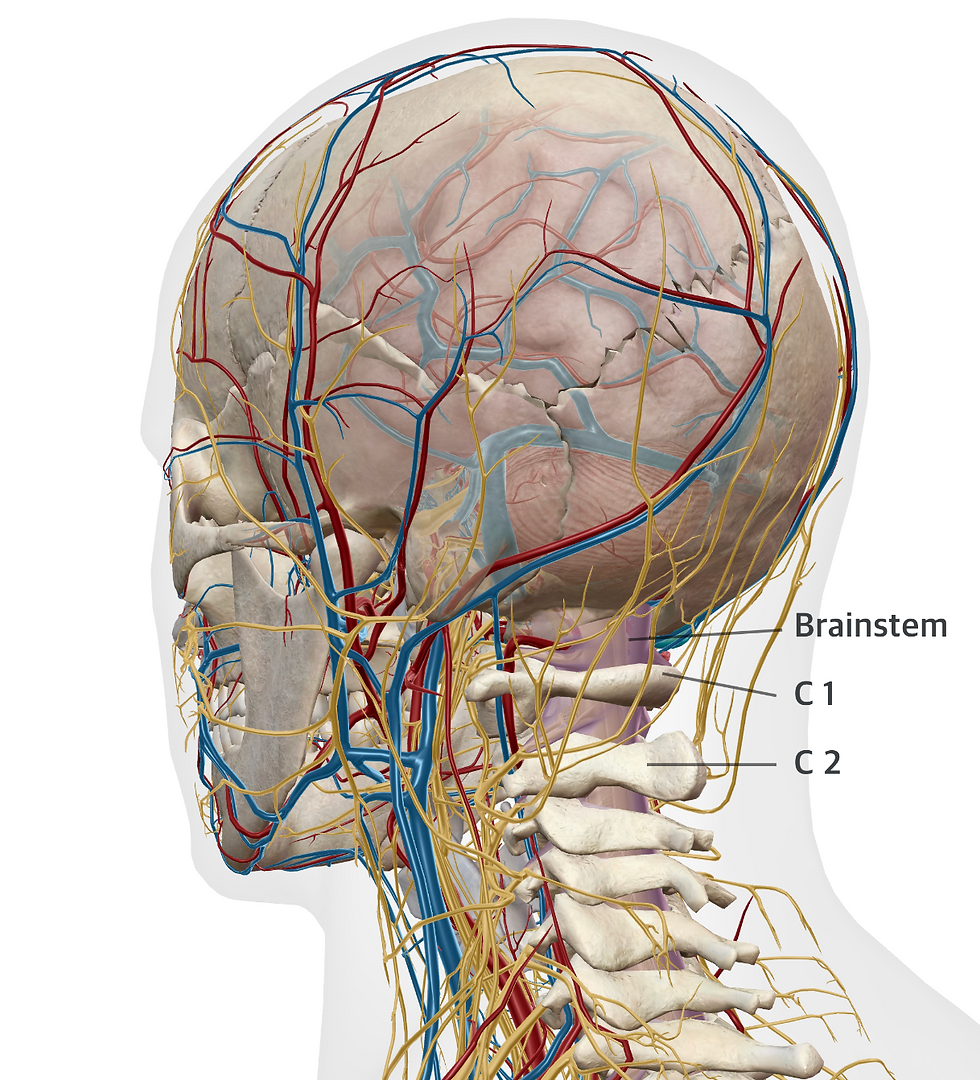
Upper Cervical Misalignment and Its Impact
Upper cervical misalignment refers to physical displacement or mechanical compromise in the atlas (C1), axis (C2), or occiput (C0). Causes can include trauma, whiplash, poor posture, and long-term degeneration. Even small shifts can irritate or compress structures surrounding the brainstem, upper spinal cord, and other soft tissues (nerves and blood vessels) around head and neck.
Because this region contains the densest concentration of neurological pathways in the body, patients frequently report:
Head heaviness
Brain fog / unclearness
Occipital or tension headaches
Neck pain
Facial tightness or jaw discomfort
Visual shimmer or instability
Dizziness or imbalance
Difficulty initiating a swallow
The cranio-cervical junction contains some of the most neurologically dense anatomy in the body, which explains why symptoms can feel severe or wide-ranging even with minimal misalignment.
Functional Upper Cervical Misalignment: When Imaging Looks “Normal”
A patient may have significant symptoms, yet MRI or CT imaging appears “normal.” This happens because functional misalignment affects proprioception and muscle control, not always visible on static imaging.
When deep stabilizing muscles underperform, superficial muscles tighten to compensate. This creates stiffness, fatigue, and spasms. Over time, the brain receives distorted information about head position, leading to those neurological symptoms.
This is common in patients seeking upper cervical chiropractors in New York because the nervous system relies heavily on accurate signals from the cranio-cervical junction to orient the body in space.
The proprioceptive system can become “noisy,” disrupting how the brain interprets head and neck position.
Jaw, Tongue, and Swallowing: The Neck–Jaw Relationship
Clenching increases tension through the suprahyoid and infrahyoid muscles, which connect the jaw, tongue, and throat directly to the upper neck. This tension chain explains why TMJ problems, swallowing difficulty, and neck symptoms are deeply interconnected.
Patients may feel:
Throat tightness
A delayed swallow
Clicking in the jaw
Difficulty speaking or projecting the voice
Even when ENT or GI testing comes back “normal,” upper cervical misalignment can still be the underlying driver.
Why Standard Imaging Often Misses Upper Cervical Misalignment
Most MRIs and CT scans are done lying down, in a neutral position. But upper cervical misalignment is often dynamic, meaning symptoms appear when turning, bending, or simply being upright.
This is why comprehensive evaluation matters, including:
CBCT imaging
Upright or functional studies when appropriate
Precise upper cervical analysis
Postural and proprioceptive testing
Jaw and tongue coordination assessment
Neurological screening
At New York Upper Cervical Chiropractic in Great Neck, we combine structural imaging (3D CBCT) with functional testing to find the real cause.
Treatment Approaches
Correcting misalignment (structural and functional) may require:
Precise, gentle upper cervical correction
Postural retraining
Activity modification
Rest and tissue recovery
Correcting overall lifestyle
Most patients improve through a combination of restoring alignment and retraining the stabilizing system.
Local Relevance: Upper Cervical Care in New York, Great Neck, Long Island, and Queens
People across Great Neck, Manhasset, Little Neck, Bayside, Flushing, and the greater Long Island region frequently visit for symptoms that remain unsolved elsewhere. Many have seen all kinds of specialists before finally discovering that a small area at the top of the neck was affecting their entire system.
This is why upper cervical misalignment deserves clinical attention—and why specialized upper cervical chiropractic care is becoming increasingly recognized.
Upper cervical misalignment is often overlooked, yet it plays a powerful role in balance, vision, swallowing, posture, autonomics, and whole-body regulation. Whether you’ve been dealing with dizziness, heavy-head sensation, TMJ tension, headaches, or unexplained neurological symptoms, understanding the cranio-cervical junction may be the missing link.
If you live in Great Neck, Long Island, Queens, or anywhere in New York, and your symptoms remain unresolved, upper cervical evaluation may help you finally get answers—and start healing with a gentle, scientifically grounded approach.


